Rough roads, real bills: why road quality is a household cost issue
In a district where the car is often the only practical way to get to work, school, appointments or the weekly shop, road condition belongs in the cost-of-living conversation. The bill does not arrive as a neat council invoice. It turns up gradually in fuel, tyres, servicing, freight and time.
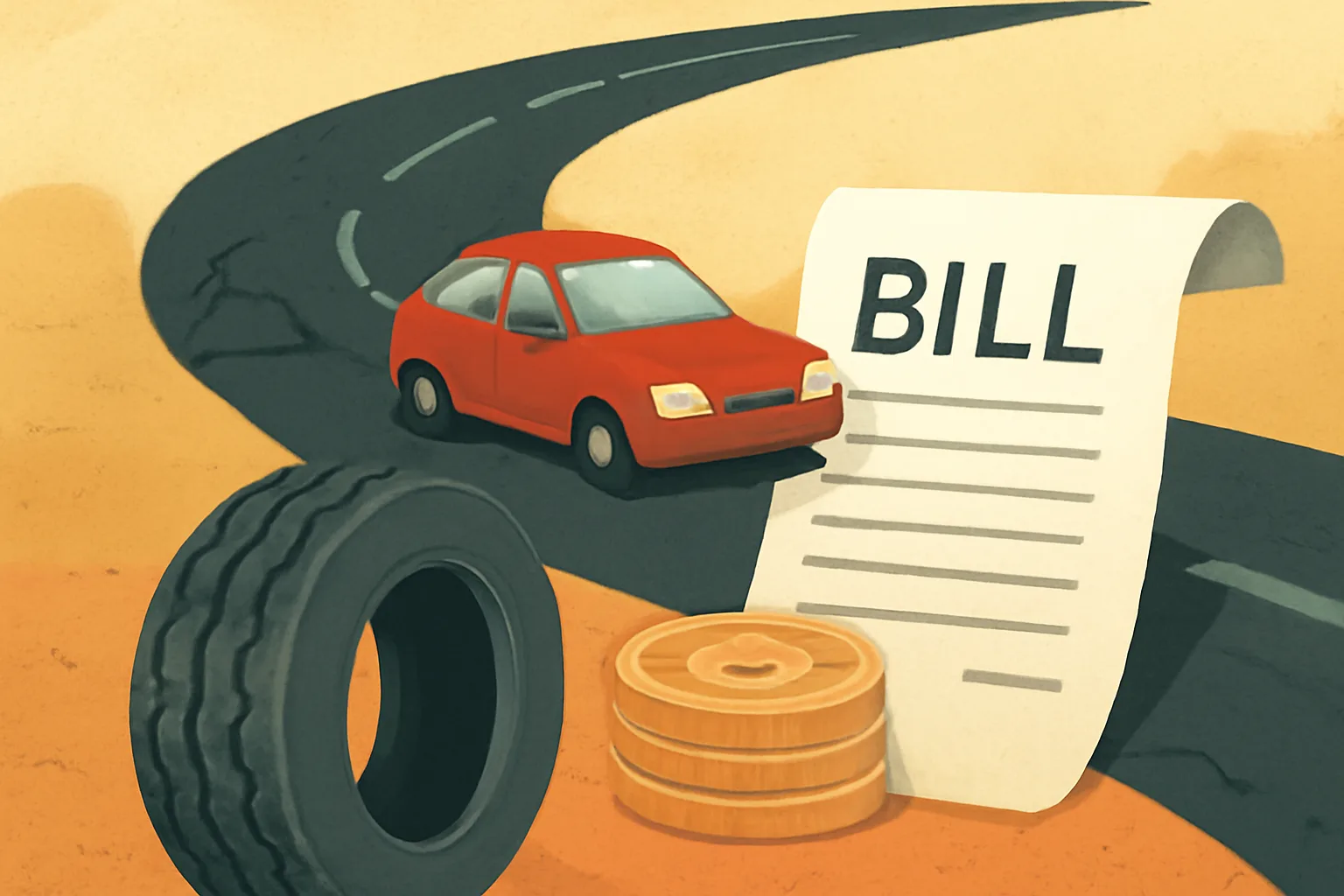
A rough patch on the way into Tumut rarely announces itself as a cost-of-living problem. It is just another bump, another rattle from the back, another careful line around a broken edge after rain.
But in the Snowy Valleys, where households often rely on a car for work, school, sport, medical appointments and groceries, road condition and household spending are closely connected. The cost does not land all at once. It accumulates through fuel, tyres, wheel alignments, suspension wear, slower trips and the price of moving goods into town.
That does not mean every pothole causes a repair, or that every workshop bill can be blamed on a council road. Cars wear out for all sorts of reasons. The stronger and more useful point is that road quality affects vehicle operating costs across an entire network — and the research used by Australian transport agencies accounts for exactly that.
A household transport bill already has plenty in it
The Australian Automobile Association’s Transport Affordability Index models the weekly costs faced by a typical two-car household, including finance, registration, insurance, fuel, servicing, tyres and roadside assistance.
For the March quarter of 2026, its Wagga Wagga benchmark household had transport costs of $412.74 a week — about $21,462 over a full year if that weekly figure held steady. The average across the index’s regional benchmark centres was higher again at $431.29 a week.
Those figures are not estimates for Tumut and should not be treated as a local household survey. They are useful because they show the scale of the transport burden in a regional setting. Once a family budget is carrying fuel, insurance, registration and car repayments, an unexpected tyre or front-end repair is not a minor inconvenience. It can knock the week sideways.
Tumut households can at least keep an eye on one variable through the Tumut fuel prices utility. Road wear is harder to put on a dashboard, but it belongs in the same conversation.
What a rougher surface does to a vehicle
The Bureau of Infrastructure and Transport Research Economics describes several ways pavement roughness raises road-user costs. A rougher surface increases rolling resistance, which can add to fuel consumption. It also increases wear and tear on tyres and suspension components.
Australian transport modelling examined by BITRE estimated that, across the roughness range used in its case study, vehicle operating costs for a medium-sized car rose by around 3 per cent for each additional unit on the International Roughness Index. The effect was larger for articulated trucks.
That is modelling, not a promise that a particular road will add a set number of dollars to a particular service. Vehicle type, speed, tyre profile, load, driving style and the exact road defect all matter. Still, the direction is clear: smoother roads generally cost road users less.
The most visible risks are familiar:
- tyre cuts, bulges and pressure loss after a sharp impact
- bent wheels or damaged wheel alignment
- extra shock absorber, bush and suspension wear
- increased vibration and rattles
- more fuel used as rolling resistance rises
- slower travel where drivers must negotiate damaged surfaces carefully
Some problems appear immediately. Others arrive as uneven tyre wear or a steering vibration several weeks later, which makes the cause difficult to pin down.
The cost does not stop with the family car
Road roughness affects trucks more heavily than passenger cars in the BITRE modelling. That matters locally because a rural road network is not used only for the school run.
It carries timber, farm inputs, livestock, trades, couriers, supermarket freight and the service vehicles that keep smaller communities connected. Higher tyre, fuel, maintenance and travel costs for those operators do not necessarily stay with the operator. Over time, some of that pressure can flow into delivery charges, contract prices and the shelf price of goods.
There is also a time cost. A ten-minute delay once is forgettable. A slower section travelled repeatedly for work, appointments or school activities becomes hours over a year. For a tradie crossing the district between jobs, unreliable travel time can also mean fewer workable hours in the day.
This is why rural road quality is more than an infrastructure talking point. It affects household budgets directly through the car and indirectly through the local economy.
Maintaining a very large network is the awkward bit
Snowy Valleys Council says it manages about 700 kilometres of sealed roads and 475 kilometres of unsealed roads, as well as roughly 168 kilometres classified as regional roads. Spread that across the district’s towns, villages, valleys and mountain country and the scale of the job becomes fairly plain.
Council’s published guide says it typically spends about $3.1 million a year on maintenance such as pothole repairs, gravel-road grading and vegetation control, plus around $4.5 million on renewals and new construction. It also receives state and federal road funding.
There is an important difference between patching, resealing, rehabilitation and full reconstruction:
Patching buys time
A pothole patch deals with an immediate risk and helps stop water getting further into the pavement. It does not turn an ageing road into a new one.
Resealing protects what is underneath
A reseal may look less urgent than fixing the roughest road in the district, but timely sealing can prevent water damage and extend the pavement’s useful life. Waiting until failure is obvious is often the dearer approach.
Rehabilitation tackles the pavement itself
Where the underlying layers have deteriorated, a surface treatment is not enough. Rehabilitation is more substantial and more expensive, but it addresses structural problems rather than repeatedly treating the symptom.
That distinction matters when residents see one street being resealed while another still has patches. Road programs must balance immediate hazards with preventive work that avoids a much larger reconstruction bill later.
What is happening around Tumut
Snowy Valleys Council reported that its 2025–26 Roads to Recovery program included resealing on Boundary Street, Wynyard Street and Merivale Street in Tumut. The previous program year included Tumut Plains Road and Dalhunty Street, along with works elsewhere across the region.
The council received a $7.67 million allocation under the Australian Government’s Roads to Recovery program, delivered over five years. Planning for the next round was still being finalised after winter when council published its June 2026 update, so individual project details should be checked as programs are confirmed.
Heavy project traffic is another part of the local equation. Council’s half-year reporting said maintenance agreements were in place for 49 roads covering 237 kilometres affected by HumeLink activity. Those agreements were valued at about $3.5 million over two years and are intended to fund maintenance during the project period. Their existence is important: large infrastructure projects need road impacts identified, monitored and paid for rather than quietly shifted onto local ratepayers and motorists.
What drivers can do without pretending the road bill is theirs alone
Householders cannot reseal a road, but a few practical habits can reduce the chance that a rough trip becomes an expensive one.
Keep tyres correctly inflated. Underinflation increases heat and fuel use; overinflation can reduce the tyre’s ability to absorb an impact. Use the vehicle manufacturer’s recommended pressures rather than the maximum printed on the tyre wall.
Do not ignore new vibration or pulling. A changed steering feel, pressure warning, visible sidewall bulge or fresh vibration deserves attention. The Tumut.org business directory lists local automotive businesses, including Anderson Automotive Tumut and Rural 4x4 Tumut, if you need to locate a nearby operator and confirm available services.
Report hazards accurately. Council says community reports help its inspectors manage the network. Include the road name, nearest intersection or property number, direction of travel and a clear description. Only take photographs where it is safe to do so.
Send the report to the correct road authority. The Snowy Mountains Highway is maintained by the NSW Government. Other state roads in the district include Gocup Road, Batlow Road and Tumbarumba Road, although council undertakes work on some state routes under contract. Local and regional road issues generally go to Snowy Valleys Council; state-road concerns can be lodged with Transport for NSW.
Record a serious incident. If a road defect is followed by apparent vehicle damage, note the time and precise location and keep photographs, repair assessments and receipts. That record does not establish who is responsible, but it is far more useful than trying to reconstruct the details later.
Road spending is preventive household economics
A well-timed reseal is not especially dramatic. There is no ribbon-cutting glamour in stopping water from reaching the road base. Yet preventive maintenance is often where public spending can avoid larger costs — for the council responsible for rebuilding the road and for the people driving over it every day.
The Snowy Valleys road network must serve low-volume rural lanes, busy town streets, freight routes and long connections between communities. Not every surface can be renewed at once, and not every bump is evidence of neglect.
But road quality should be judged as more than a line in a capital-works budget. Around Tumut, the road is part of the household balance sheet. When it deteriorates, the cost has a habit of finding its way to the fuel pump, the workshop counter, the delivery invoice and, eventually, the kitchen table.
Sources
Businesses mentioned in this guide
Open the Tumut.org listing for local details, directions and available contact information.
Frequently asked questions
Does Snowy Valleys Council manage every road around Tumut?
No. Snowy Valleys Council manages local and regional roads, while some major routes are state roads. The Snowy Mountains Highway is maintained by the NSW Government, while roads including Gocup Road, Batlow Road and Tumbarumba Road are state roads maintained with council assistance under contract. Check the road authority before lodging a report.
How do I report a pothole or damaged road near Tumut?
For a council-managed road, use Snowy Valleys Council’s online road-issue request form and give a precise location, direction of travel and description of the hazard. Concerns about state-managed roads should be reported to Transport for NSW. Photos can help where it is safe and lawful to take them.
Does a rough road really increase fuel and maintenance costs?
Australian transport modelling recognises that increasing pavement roughness raises rolling resistance and contributes to additional fuel use, tyre wear and suspension wear. That does not mean every rough section causes immediate damage, but repeated travel across a poorer surface can increase vehicle operating costs over time.
What should I check after hitting a deep pothole?
Look for tyre bulges, cuts, pressure loss, a bent rim, warning lights, steering vibration or a vehicle that pulls to one side. Do not crawl beneath a vehicle on the roadside. If anything feels different, arrange an inspection with a qualified automotive business rather than waiting for the next scheduled service.